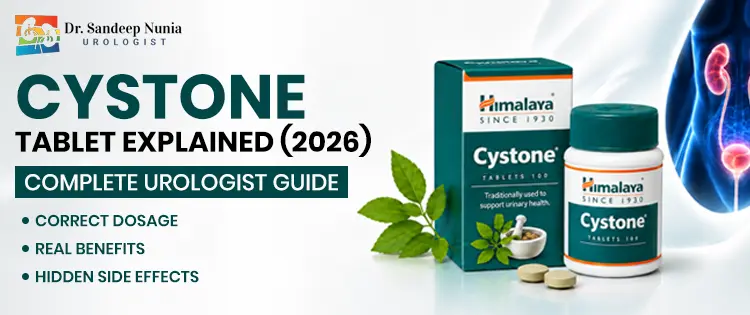
Cystone Tablet Explained: Uses, Right Dosage, Real Benefits & Side Effects: A Urologist’s Complete Guide (2026)
What is Cystone tablet used for, and how much should you actually take? In short, Cystone tablet uses centre on managing and preventing kidney stones, though many patients also take it for recurrent urinary infections. Most adults are guided towards a fixed Cystone tablet dosage for adults.
But the exact number your doctor prescribes will depend on whether you’re managing an active stone, preventing a new one, or dealing with a UTI flare. This blog breaks down the usage, dosage, benefits and side effects of the Cystone tablet, without the jargon and without the exaggerated claims that a lot of Ayurvedic content sites tend to make.
Disclaimer: This information is for general knowledge and isn’t a substitute for professional medical advice.
What Is Cystone Tablet?
Cystone is an Ayurvedic proprietary medicine made by Himalaya Wellness. Some of the most common Himalaya Cystone tablet uses include supporting urinary tract health and managing kidney stones. It’s been around for decades and is one of the most widely recognised medicines prescribed in Indian urology clinics, largely because it’s affordable, well tolerated, and easy to combine with conventional treatment when needed. What sets it apart from a lot of newer herbal supplements is that it’s been studied and used consistently enough that most urologists in India have a fairly settled opinion on where it helps and where it doesn’t, rather than treating it as an unknown quantity.
Composition and Key Ingredients (Table)
The Cystone tablet ingredients are a blend of herbal extracts and mineral-based powders, each included for a specific traditional and pharmacological property.
| Ingredient | Form | Quantity |
| Shilapushpa (Didymocarpus pedicellata) | Extract | 130 mg |
| Pashanabheda (Saxifraga ligulata syn. Bergenia ligulata) | Extract | 98 mg |
| Manjishtha (Rubia cordifolia) | Extract | 32 mg |
| Nagarmusta (Cyperus scariosus) | Extract | 32 mg |
| Apamarga (Achyranthes aspera) | Extract | 32 mg |
| Gokshura/Gohija (Onosma bracteatum) | Extract | 32 mg |
| Sahadevi (Vernonia cinerea) | Extract | 32 mg |
| Hajrul yahood bhasma | Powder | 32 mg |
| Shilajeet (Purified) | Powder | 26 mg |
How Cystone Works (Mechanism of Action)
- Reduces the concentration of stone-forming substances such as calcium and oxalate in the urine.
- Breaks down the mucin that binds crystals together, which is what allows small stones to fragment.
- It increases overall urine flow, helping flush out crystals before they grow large enough to cause pain.
Cystone Tablet Uses
The core of Cystone tablet uses is stone management, but the formulation touches several related areas of urinary health, which is why patients often ask about it for more than one reason at a time.
Kidney Stone Management
For active kidney stone treatment, Cystone is generally used alongside hydration and dietary changes rather than as a standalone cure, particularly for stones under a certain size. It’s most effective on small, non-obstructive stones, and it should always be paired with imaging follow-up to track whether the stone is actually shrinking or passing.
Patients who combine it with genuine lifestyle changes, rather than treating it as a magic pill, tend to have a much smoother course, whereas those who rely on the tablet alone while ignoring hydration advice often don’t see the improvement they were expecting.
Urinary Tract Infection (UTI) Relief
One common use of Cystone tablet is as supportive therapy during a UTI, since its mild antimicrobial and anti-inflammatory action can ease burning and discomfort. It is not a replacement for antibiotics when a bacterial infection is confirmed, and this distinction matters because Ayurvedic marketing sometimes blurs that line. If a urine test shows a confirmed bacterial infection, Cystone can be taken alongside a prescribed antibiotic course as supportive care, but it shouldn’t be the only treatment used.
Preventing Stone Recurrence
Long-term Cystone use includes reducing the chance of a stone coming back once the first one has passed or been treated. Recurrence is a genuine clinical concern, with data showing roughly 26% of first-time stone formers develop another stone within five years.
That’s precisely why prevention gets as much attention in my clinic as treating the stone itself, since the goal isn’t just to clear one episode but to change the underlying pattern that led to it.
Natural Kidney Detox and Flushing Small Crystals
Cystone’s diuretic action supports what’s often called a kidney detox, meaning it helps flush out fine crystalluria before those crystals aggregate into a stone. Pairing this with a proper kidney detox and hydration routine makes a measurable difference.
Other / Off-Label Uses
Some patients use Cystone for general urinary discomfort, mild bladder irritation, or as a preventive measure if they have a strong family history of stones. These uses are less studied and should always be discussed with a doctor rather than self-prescribed, particularly since family history itself is already a recognised risk factor that may warrant closer monitoring beyond what a herbal tablet alone can offer.
Cystone Tablet Benefits
The benefits of Cystone tablet show up most clearly when it’s used consistently and alongside proper hydration, not as an isolated fix. Here are the benefits:
- Helps break down and reduce the size of small urinary stones
- Supports smoother, less painful passage of stone fragments
- Eases burning sensation and discomfort linked to UTIs
- Maintains a healthy urinary pH, making it harder for new stones to form
- Generally well tolerated, with a low reported rate of adverse effects
Cystone Tablet vs Cystone Forte vs Cystone Syrup
The three formats share a similar herbal base but differ in strength, dosing convenience, and who they’re best suited for, which matters more than most patients realise when they’re choosing between them. Cystone Forte tablet uses overlap heavily with the standard tablet, but Forte is designed for a more concentrated, once-a-day-friendly dose. Cystone syrup is often chosen for children or anyone who struggles to swallow tablets.
Comparison Table (Format, Dose, Best Suited For)
Product Format Typical Dosing Pattern Best Suited For Cystone Tablet Tablet 2 tablets twice daily Standard adult stone management and prevention Cystone Forte Tablet 2 tablets twice daily Adults wanting fewer daily doses Cystone Syrup Liquid 1-2 teaspoons (5-10 ml) twice daily for adults ½-1 teaspoon (2.5 to 5 ml) twice daily for children Children, or adults who prefer liquid dosing
Note: Always consult your doctor before using this.
Cystone Tablet Dosage: How Much and How Often Should You Take It?
| Product | Format | Typical Dosing Pattern | Best Suited For |
| Cystone Tablet | Tablet | 2 tablets twice daily | Standard adult stone management and prevention |
| Cystone Forte | Tablet | 2 tablets twice daily | Adults wanting fewer daily doses |
| Cystone Syrup | Liquid | 1-2 teaspoons (5-10 ml) twice daily for adults ½-1 teaspoon (2.5 to 5 ml) twice daily for children | Children, or adults who prefer liquid dosing |
Note: Always consult your doctor before using this.
The manufacturer’s general guidance for the Cystone tablet dosage for adults is 2 tablets taken twice daily. But your doctor may adjust this based on stone size, kidney function, or whether you’re managing an infection alongside the stone. Always consult your urologist to know the correct dosage for your condition.
Adult Dosage Table by Condition
Condition Suggested Frequency* Notes Active kidney stone 2 tablets, twice daily Alongside imaging follow-up Recurrence prevention 2 tablets, twice daily or as advised Often continued long-term UTI-related discomfort As directed by physician Not a substitute for antibiotics
| Condition | Suggested Frequency* | Notes |
| Active kidney stone | 2 tablets, twice daily | Alongside imaging follow-up |
| Recurrence prevention | 2 tablets, twice daily or as advised | Often continued long-term |
| UTI-related discomfort | As directed by physician | Not a substitute for antibiotics |
Cystone tablet how many times a day is one of the most common questions asked by patients. The honest answer is that it varies by condition, so please don’t self-adjust the dose based on something you’ve read online. A dose that works for prevention isn’t necessarily the same one your doctor will want you on while a stone is actively passing. Adjusting it yourself without imaging to guide you can mean missing the point where a stone actually needs surgical intervention instead.
How to Take Cystone Correctly
Cystone is best taken after meals with a full glass of water, which helps with absorption and reduces any mild stomach upset. Drink 2 to 3 litres of water daily while taking Cystone, since the tablet’s diuretic action only works well when there’s enough fluid moving through the kidneys to flush crystals out.
Spacing your water intake evenly through the day, rather than drinking most of it in one sitting, tends to be more effective for keeping urine consistently dilute. For a fuller breakdown of fluid and food choices that support stone prevention, our kidney stone diet and hydration guide covers this in more depth.
How Long Does Cystone Tablet to Work
Most patients on a standard Cystone tablet dose notice symptom relief, like reduced burning or discomfort, within a couple of weeks, but actual stone dissolution takes considerably longer and depends heavily on stone size and composition. Pain easing off doesn’t always mean the stone itself has moved or reduced in size. So, a follow-up ultrasound is recommended at the six- to eight-week mark to check whether the stone is actually shrinking rather than relying on symptoms alone.
Cystone Tablet Side Effects: What to Watch For
Genuine side effects of Cystone tablet are uncommon, and manufacturer data hasn’t reported significant adverse reactions when the medicine is taken as prescribed. That said, “uncommon” doesn’t mean “never,” so it’s worth knowing what to watch for.
Common Side Effects
Cystone tablet side effects, when they do occur, are usually mild. They might include the following:
- Mild stomach discomfort or bloating
- Occasional nausea, particularly if taken on an empty stomach
- Rare allergic skin reactions in sensitive individuals
When to Stop and Consult a Doctor
Stop taking Cystone and speak to your doctor if you notice:
- A skin rash
- Persistent stomach pain
- Any signs of an allergic reaction such as swelling or difficulty breathing
These reactions are rare, but they’re not something to wait out at home, and it’s always better to have a quick check than to assume a symptom will pass on its own.
Drug Interactions and Precautions
Cystone is generally considered low-risk for interactions, though anyone on regular prescription medication should still flag it to their doctor before starting. Check out this pharmacology reference to look into the safety data yourself.
Who Should Avoid Cystone
Cystone isn’t recommended for patients with complete ureteral obstruction, since the manufacturer’s own product literature specifically advises against it in that situation. Anyone with a known allergy to any of its herbal ingredients should also avoid it. Patients with significant kidney impairment should only use it under direct medical supervision rather than as an over-the-counter choice.
Pregnancy, Breastfeeding and Children
Manufacturer information indicates Cystone is generally considered suitable during pregnancy. But this is a decision that should be made after consulting your treating obstetrician or urologist, not with a product label. For children, the syrup form is typically preferred, again strictly under medical supervision and at a dose confirmed by a paediatrician or urologist rather than extrapolated from the adult tablet dose..
When to See a Urologist
Don’t wait out the following symptoms at home, since they can point to a stone that’s stuck, infected, or causing kidney damage. Book an appointment with your urologist when you notice the following:
- Severe or worsening pain that isn’t controlled by usual painkillers
- Fever or chills alongside stone symptoms
- Blood in the urine
- Inability to urinate at all
- No improvement after several weeks of home management or Cystone use
Why Choose Dr Sandeep Nunia, Best Urologist Surgeon in Jaipur
Dr Sandeep Nunia is widely regarded as the best urologist surgeon in Jaipur, bringing years of hands-on surgical and clinical experience in stone disease, endourology, and general urological care.
Here’s what patients consistently value about his approach:
- Clear, unhurried communication, with time taken to explain the reasoning behind a treatment plan rather than just handing over a prescription
- Individualised assessment, since two patients with what looks like the same stone on paper can need completely different approaches depending on kidney function, stone composition, and recurrence history
- Judgement built on hands-on experience, having personally managed hundreds of stone cases rather than relying on generic protocols
- A treatment philosophy that weighs conservative management against surgical intervention on a case-by-case basis, instead of defaulting to one approach
That kind of judgement is exactly what a herbal-only source or a generic health blog can’t offer. For anyone dealing with recurrent stones, unclear symptoms, or simply wanting a second opinion, a consultation with a named, experienced specialist like him is recommended.
FAQs
Is Cystone good for kidney stones?
Yes, Cystone is commonly used to help manage small kidney stones and reduce the risk of recurrence. It works best when combined with proper hydration. It isn’t intended as a sole treatment for larger and obstructive stones.
How many Cystone tablets should I take per day?
The general adult guidance is 2 tablets twice daily, though your exact dose should always be confirmed by your doctor. This can vary depending on the stone size and whether you’re managing an active infection alongside it.
Does Cystone dissolve kidney stones?
Cystone can help reduce the size of small stones and ease their passage, but it doesn’t dissolve every type or size of stone. Larger or obstructive stones typically need surgical or procedural intervention instead.
Can Cystone be taken with other medicines?
Cystone is generally considered low-risk alongside most medications, but you should always inform your doctor about anything else you’re taking. This is especially important if you’re on regular prescription drugs for another condition.
What are the side effects of Cystone tablet?
Reported side effects are uncommon and usually mild, such as stomach discomfort or nausea. Rare allergic reactions can occur, and you should stop use and consult a doctor if this happens.
How long should I take Cystone tablets?
Duration depends on whether you’re treating an active stone or preventing recurrence, and this should be set by your doctor based on follow-up scans. Many patients continue it long-term for prevention once the initial stone has passed.
Can Cystone be taken during pregnancy?
Manufacturer information suggests Cystone is generally considered safe during pregnancy, but this decision should always be confirmed with your obstetrician or urologist. Self-medicating during pregnancy is never advisable, regardless of a product’s general safety profile.
How does Cystone tablet work?
It works by reducing stone-forming substances in the urine, breaking down the mucin that binds crystals together, and increasing urine flow to help flush out small particles. This combined action supports both stone prevention and easier passage of existing fragments.
What is the difference between Cystone Tablet and Cystone Forte?
Cystone Forte is a more concentrated formulation designed for fewer daily doses. But the standard tablet is typically taken more frequently throughout the day. Both share a similar herbal base but differ in strength and dosing convenience.

DR. SANDEEP NUNIA
urology, urogynaecology, renal transplant, and advanced laparoscopy
Dr. Sandeep Nunia is one of the best urologists in Jaipur, Rajasthan, having experience of several years in urology, urogynaecology, renal transplant, and advanced laparoscopy. He is currently working in Manav Hospital , VKIA, Jaipur, and Pacific Diagnostic center, Vaishali Nagar, Jaipur, as Head Urology Consultant.
Know More →