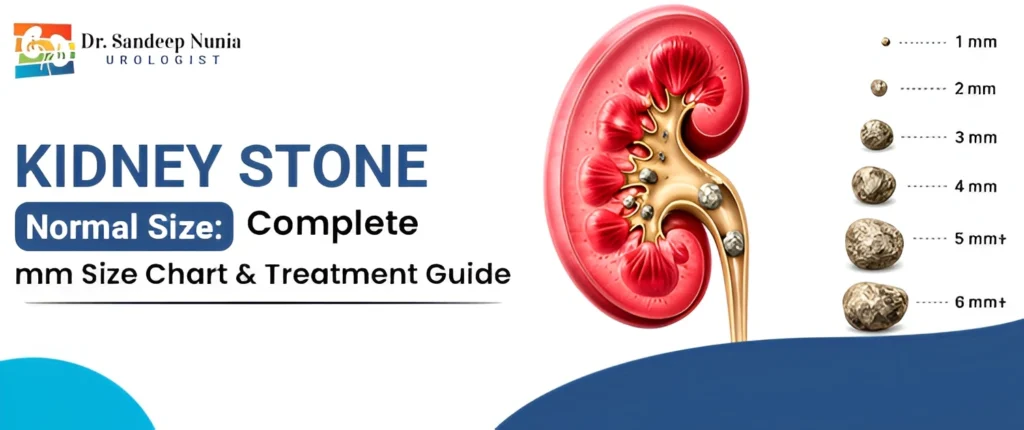
Kidney Stone Normal Size: Complete mm Size Chart & Treatment Guide
What size kidney stone will pass on its own? Most of the kidney stones smaller than 4 mm pass on their own with water. If a kidney stone is over 6 mm, passing it naturally can become much harder and may require surgery. This is why the kidney stone normal size is the first thing worth checking to understand the severity of the condition. That figure explains whether you need urgent medical assistance or if it will pass on its own.
However, size is not the only consideration for kidney stones. The best urologist surgeon in Jaipur also seeks the stone’s location within the urinary tract, its shape and the severity of symptoms influence the overall condition. This guide outlines the size chart of kidney stones, treatment thresholds and at which point you need to consult a urologist surgeon in Jaipur.
What Is Considered a Normal Kidney Stone Size?
There is no medically normal size for a kidney stone. This is because any stone is an abnormal mineral deposit in the urinary tract. However, doctors often assess kidney stones in mm to identify if the stone will pass naturally or need medical intervention. Most of the kidney stones found on medical scans are often reported between 2mm and 10 mm.
Clinical “Normal” vs Practical “Normal”
In clinical terms, there is no normal size of a kidney stone. When patients ask about the normal kidney stone size in mm, they want to know if the stone will pass naturally or if it will need a procedure. As per the NIDDK, the size of kidney stones may vary from a grain of sand to as large as a pea, and sometimes it can even be larger.
Why Size Alone Doesn’t Tell the Whole Story?
The size of the stone within the kidney is important, but it is not the only factor that guides treatment. For example, a 3 mm stone stuck in the ureter can cause severe pain or vomiting. In contrast, a larger stone that stays quietly inside the kidney may cause few or no symptoms for some time.
Kidney Stone Size Chart in mm and Treatment
A kidney stone size chart helps doctors to estimate the treatment plan through medicines, surgery or whether it will pass naturally. The European Association of Urology (EAU) groups stones by size, such as under 5 mm, 5 to 10 mm, 10 to 20 mm, and above 20 mm. Here’s a brief chart of different sizes of kidney stones:
| Kidney Stone Size | Chance of Passing Naturally | Common Treatment Approach |
| Under 4 mm | High | Hydration, pain relief, observation, follow-up |
| 4 mm to 6 mm | Moderate | Medicines, monitoring, pain control and urologist review |
| 6 mm to 10 mm | Lower | Medical expulsive therapy, close follow-up, and possible procedure |
| Above 10 mm | Low | Usually needs active treatment such as URS, RIRS, ESWL, or PCNL |
| Above 20 mm | Very low | Often treated with PCNL or another planned surgical approach |
Small Stones (Under 4mm)
Kidney stones smaller than 4mm may naturally pass through urine. To smooth this process, doctors often recommend adequate fluid intake, pain relief medicines, urine straining and follow-up imaging if needed.
Medium Stones (4mm-10mm)
Stones that are between 4 mm and 10 mm need closer medical attention. To treat this condition, your doctor may prescribe alpha blockers for easily passing stones from the body.
Large Stones (Above 10mm)
Stones that are sized 10 mm or more may need procedures such as RIRS, ureteroscopy, shock wave lithotripsy or PCNL. The treatment choice also depends on the hardness, size, location and kidney health condition.
What Does Your Stone Size Actually Look Like?
A kidney stone may look tiny on scan reports. But in reality, a 2mm kidney stone’s actual size can be close to a grain of sand or a mustard seed. Similarly, a 4mm kidney stone actual size can be closer to a sesame seed or a small peppercorn.
The following is a quick comparison of the kidney stone size with real-life objects to get a clear idea of how severe it could be:
| Kidney Stone Size | Actual Size Comparison | What does it usually mean? |
| 1 mm to 2 mm | Grain of sand | Often passes naturally, but may still cause discomfort |
| 3 mm to 10 mm | Pebble | Good chance of passing, but pain may occur if it enters the ureter |
| Above 10 mm | Golf-ball-sized | Needs specialist evaluation and planned treatment |
Kidney stone symptoms are not always proportional to the stone size. That is why a detailed kidney stone symptoms guide can help you understand the patterns of kidney stone pain.
How Does Kidney Stone Size Affect Symptoms?
The relationship between the kidney stone size and symptoms mainly depends on where the stones are located, whether they are moving or blocking the urine flow. Kidney stone symptoms often show when a stone moves, irritates the urinary tract or affects the urine drainage.
Why Can Small Stones Hurt More?
Because of their tiny size, small stones can easily move in the renal system and cause pain when they travel through the ureter. The ureter tube is narrow and sensitive. For that reason, even a 2 mm or 4 mm stone may trigger the following symptoms:
- Spasms
- Nausea
- Vomiting
- Burning urination
- Blood in urine
Why Can Large Stones Stay Silent?
Large stones’ symptoms remain unnoticed because they do not interfere with the urine flow. Some of these stones are detected only through an ultrasound, CT scan or routine health check-up. But you should take large silent stones seriously. If these stones increase in size, they may cause infection, affect kidney function or block the urine drainage.
What Size of Kidney Stone Requires Surgery?
Surgical procedures are typically preferred when the stone is larger than 10 mm or causes severe pain that does not go away with medication. Doctors assess the kidney stone size for surgery along with CT or ultrasound reports, results from urine tests, pain severity and kidney function.
The most preferred approaches to treat kidney stone condition are as follows:
| Stone Size | Usual Approach | When may surgery be needed? |
| Under 4 mm | Observation, fluids, pain relief | Rarely, unless there is infection, blockage, or severe pain |
| 5 mm to 10 mm | Medicines, monitoring and possible procedure | If the stone does not pass or symptoms continue |
| Above 10 mm | Surgical treatment | Often, PCNL, URS or another specialist procedure |
If a surgical procedure has been suggested to treat kidney stones, the choice between RIRS, URS and PCNL also affects the recovery time and overall kidney stone treatment in jaipur.
How Is Kidney Stone Size Measured?
The size of kidney stones is measured in millimetres. The most common instruments to measure kidney stones are CT KUB, ultrasound or X-ray. Here’s a brief look at each method:
Ultrasound vs CT KUB vs X-ray
The kidney stone size on ultrasound report may appear as an object with a bright focus and a shadow behind it. An ultrasound report may also show signs of kidney swelling and larger stones. However, it may miss detecting very small stones or stones located in the ureter.
On the other hand, CT KUB gives clear details about the kidney stone size on CT scan report. This includes the size, location and possible obstruction caused by the stone. Whereas X-rays show stones that contain calcium.
The following table represents a side-by-side view of possibilities and limitations in detecting kidney stones from each method:
| Test | What does it show best? | Limitations |
| Ultrasound | Kidney stones, swelling, obstruction signs | May miss small ureter stones |
| CT KUB | Exact size, location, number and obstruction | Involves minor radiation |
| X-ray KUB | Some calcium-containing stones | May miss uric acid stones and small stones |
Reading Your Own Scan Report
At the time of reviewing your own kidney scan report, put more emphasis on the stone size, location, side affected and the number of stones. You should also have your scan reports reviewed by a doctor. This is because the same 5 mm stone may need different treatment depending on whether it is in the kidney, lower ureter, upper ureter or causes blockage.
Can Kidney Stone Size Reduce on Its Own?
A kidney stone typically does not wash away on its own. Some small stones may pass through urine, but most stones do not reduce in size without medical intervention. A well-planned kidney stone diet & prevention guide can help you make a safer choice for water intake as well as regular meals.
Myth vs Fact: Home Remedies and Stone Size
A common misconception among patients is that kidney stone size reduce naturally. But the real question is whether a remedy can shrink the stone, help it pass or prevent another one from forming. Here are some common myths and the actual interpretation:
| Myth | Fact |
| Water can shrink a kidney stone. | Water may help a small stone pass, not shrink it. |
| Lemon water dissolves every stone. | Citrate may lower future risk, not dissolve calcium stones. |
| Less pain means a smaller stone. | Pain may ease if the stone stops moving, but it remains. |
| Home remedies suit all small stones. | Some still need care if fever, vomiting, or blockage occurs. |
| A painless stone is harmless. | Silent stones can still grow, block urine, or cause infection. |
When Should You See a Doctor Immediately?
You should consult a doctor without any delay if you have severe pain in your lower abdomen or feel ill. Signs that indicate you need immediate doctor’s attention include:
- Fever
- Vomiting
- Reduced Urine
- Burning Urination
- Blood in Urine
These symptoms may indicate that there is a blockage in the ureter or kidney swelling. These conditions may become serious if left untreated.
Red-Flag Symptoms Checklist
If you are not sure the pain is from a kidney stone or from other conditions, these signs can lead to urgent medical care:
| Pain or Symptom | Why It Needs Attention |
| Sudden severe side or back pain | May signal a stone, infection, or urgent condition. |
| Pain in waves | May occur as a stone moves through the tract. |
| Pain spreading to lower abdomen or groin | Suggests movement through the ureter. |
| Pain with fever or chills | May indicate infection, worse with blockage. |
| Pain with vomiting | Can cause dehydration and limit medicines. |
| Pain with burning urination | May suggest infection or a lower urinary stone. |
How to Prevent Kidney Stones From Growing or Recurring?
Some feasible ways to reduce the risk of future stone formation are to control your salt intake and make changes to your diet based on previous kidney stone episodes. The most effective kidney stone prevention steps are focused on increasing water or any healthy drink intake, modifying your diet and moderating oxalate food consumption.
Hydration, Diet and Lifestyle Basics
To make the most appropriate diet for preventing kidney stones, it begins with being hydrated and limiting the intake of certain foods. Here’s a brief look at effective ways to prevent stone formation collected from the most effective kidney stone diet chart:
| Prevention Step | What to Do | Why It Helps |
| Drink enough water | More fluids during heat, exercise, or travel. | Dilutes urine and reduces crystal formation. |
| Limit salt | Cut packaged foods, chips, pickles, and processed meals. | High sodium raises urine calcium and stone risk. |
| Control oxalate foods | Limit spinach, beetroot, nuts, chocolate, tea, soy if advised. | Helps those prone to calcium oxalate stones. |
| Limit animal protein | Reduce large portions of red meat, chicken, eggs and seafood. | Excess protein raises uric acid and lowers citrate. |
| Avoid sugary drinks | Limit cola, packaged juices, high-sugar drinks. | High sugar can affect urine chemistry and stone risk. |
*The above table is for reference only. Before following any diet, consult your doctor and make a proper diet plan to prevent kidney stones.
When Should You Consult a Urologist Based on Your Kidney Stone Size?
You consult a urologist if the kidney stone is above 5 mm and the symptoms are severe. At this stage, opting for the best urologist for kidney stones matters the most because effective treatment depends on the symptoms, kidney function, location and size of stones.
Signs You Need Expert Help
Consultation from a urologist becomes essential if you notice any of the following signs:
- Repeated severe pain in the lower abdomen
- Fever or chills
- Vomiting with pain
- Reduced urine output
- Blood in urine with worsening pain
What Does a Urology Consultation Include?
A consultation with a urologist includes review of symptoms, medical scan assessment, urine test, kidney function test and planning the most appropriate treatment. If you are wondering how to choose a urologist, then follow the quick checklist below:
- Experience in kidney stone management
- Access to modern procedures
- Availability of 24/7 care
How Early Consultation Speeds Up Recovery?
Early consultation with a urologist helps to reduce pain, prevent infection and avoid the risk of kidney damage. Many patients wait until pain becomes unbearable. However, the real importance of consulting a urologist early lies in detecting risk before complications begin.
Why Choose Dr. Sandeep Nunia for Kidney Stone Treatment in Jaipur?
Dr. Sandeep Nunia is an MBBS, MS, MCh Urology specialist in Jaipur. He has more than 10 years of experience in urology with clinical work in kidney stone treatment, laser stone treatment, laparoscopic surgery, prostate care, female urology and advanced urological procedures. At the Manav Hospital in Jaipur, he offers his services as a leading kidney stone specialist.
FAQs
1. What is a normal kidney stone size?
There is no medically “normal” kidney stone size because any kidney stone is an abnormal mineral deposit.
2. What size kidney stone requires surgery?
A kidney stone above 10 mm often requires surgery or another active procedure.
3. Is a 2.7 mm kidney stone big?
No, a 2.7 mm kidney stone is considered small. It has a good chance of passing naturally, but symptoms should still be monitored.
4. Is a 4 mm kidney stone normal?
A 4 mm kidney stone is small and commonly seen on scan reports.
5. Is a 7mm kidney stone big or small?
At 7mm, a kidney stone is often characterised as a medium size that needs medical attention.
6. What is the waiting time to pass a 4mm kidney stone?
A 4 mm kidney stone typically can be passed in a time span from a few days up to several weeks. The duration also depends on the stone’s position, mobility, intensity of pain and urine flow.
7. What does a 2mm kidney stone actually look like?
The actual size of 2mm kidney stones is like a grain of sand or a small mustard seed. Even though it is small, it may be painful if it passes through the ureter.
8. How is kidney stone size measured?
Kidney stone sizes are determined in millimetres using imaging tests like ultrasound, CT KUB or X-ray.
9. Will a kidney stone pass or go away on its own?
Most kidney stones will not go away on their own. A few stones of uric acid may dissolve with some of the drugs prescribed, but the majority of calcium stones require medical intervention.
10. What is the average size of a kidney stone?
Kidney stones that are discovered during a scan often range between 2 mm and 10 mm.
11. At what time should I go to a doctor for a kidney stone?
Seek medical attention if you experience severe side or back pain, fever, vomiting, blood in the urine, burning urination or a decrease in urine output.
12. Can kidney stone size affect kidney function if left untreated?
Yes, a larger or stuck kidney stone can block urine flow and cause kidney swelling. If infection is ignored, kidney function may be affected.
13. What is the best treatment for a 10mm kidney stone?
A 10 mm kidney stone often needs active treatment, such as ureteroscopy, RIRS, ESWL or PCNL.

DR. SANDEEP NUNIA
urology, urogynaecology, renal transplant, and advanced laparoscopy
Dr. Sandeep Nunia is one of the best urologists in Jaipur, Rajasthan, having experience of several years in urology, urogynaecology, renal transplant, and advanced laparoscopy. He is currently working in Manav Hospital , VKIA, Jaipur, and Pacific Diagnostic center, Vaishali Nagar, Jaipur, as Head Urology Consultant.
Know More →