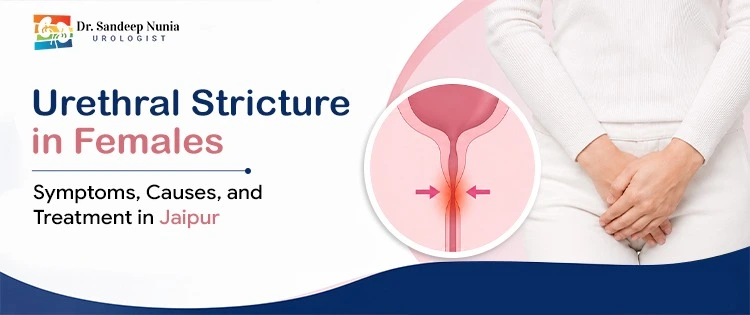
Urethral Stricture in Females: Symptoms, Causes, and Treatment in Jaipur
When talking about urinary tract complications, it’s usually the male anatomy that comes to mind. In females, however, structural obstruction such as a urethral stricture may be a serious, but under-recognized urologic problem. The tube that transports urine from the bladder to the outside is called the urethra and is a muscular tube. If scar tissue develops in this passage, it causes an abnormal narrowing that can cause normal urine to flow abnormally. The treatment of this condition is medical. When women face their lower urinary tract symptoms, they need accurate answers rather than suffer in silence and hence it’s important that they consult with a skilled female urologist in Jaipur for urethral stricture treatment in women.
What is urethral stricture in females?
Urethral stricture in females is defined as a narrowing of the urethra due to a buildup of scar tissue, which consists of dense collagenous tissue and is pathological in nature. However, do women usually suffer from urethral stricture? Statistically only occurs in a minority of women and is very uncommon. Strictures are much less common in women than in men, due to the short urethra (approximately 4 cm) in females.
Sadly, due to this presentation, a female urethral stricture, when misdiagnosed as a UTI (Urinary Tract Infection) or Overactive Bladder, is very common. Women have been taking repeated courses of antibiotics for what they think is an infection, but actually it is a structural, mechanical blockage.
Causes of urethral stricture in females
- Scar tissue may form in the female urinary channel with various different etiologies:
- Medical interventions are one of the top causes of Iatrogenic Trauma. This is because of past urethral catheterization, rough instrumentation or complications from pelvic surgery such as anti-incontinence slings, hysterectomy and anterior vaginal wall surgery.
- Accidental Trauma: Pelvic fractures from accidents, such as those in a car, or injuries from being straddled, may compress and/or otherwise damage the urethral tissues.
- Scars in the urethral meatus may occur from recurrent severe urethrotomies, chronic inflammation of the vulvovaginal tissues or inflammatory diseases such as Lichen Sclerosus.
- Malignancy or Radiation: Radiation therapy may cause changes in tissue vascularity that will result in development of dense, ischemic strictures over time in the case of gynecological or pelvic cancers.
Symptoms of urethral stricture in females
It is important to know what symptoms indicate a urethral stricture in females, because an incorrect diagnosis of the condition can prolong the problem and lead to further complications. In women, the most definitive urethral stricture symptoms are related to obstructive voiding patterns:
- Difficulty with urination, the urine may be weak and spurt or divide.
- Struggling and/or straining to urinate or void.
- A feeling of incomplete bladder emptying (urinary retention).
- Having to wait a long time to go to the toilet or dribbling at the end of the urine stream.
- Dysuria (difficulty urinating), often confused as an “always” infection.
How is female urethral stricture diagnosed?
A systematic diagnostic process must be used to identify an anatomical narrowing. An expert urologist will be able to answer the question of how is female urethral stricture diagnosed as follows:
- Uroflowmetry: An area of testing that does not require the patient to be inserted into the bladder, but instead, the patient sits in a funnel and urinates into it under controlled conditions, while the flow is measured. If the curve is long and flat, there is an obstruction.
- Post-Void Residual (PVR) Ultrasound: A post-voiding ultrasound to measure the amount of urine left in the bladder.
- The definitive diagnostic test: Cystourethroscopy. A small, lighted camera (cystoscope) is inserted into the urethra to visually examine, map, and identify the site and amount of narrowing.
- Retrograde Urethrography or VCUG: Imaging using contrast agents that outline the structure of the urethral lumen on an X-ray.
Treatment options for urethral stricture in females
If narrowing is only mild, it may be treated conservatively, although definitive urethral stricture treatment is typically a procedural or surgical procedure to open the urinary lumen in females.
- Urethral Dilation: This is performed by repeatedly inserting medical dilators or a special balloon catheter into the penis, to stretch the scar tissue. Consisting of just a few steps, dilation can provide temporary relief from dense strictures, which must be repeated from time to time, although it is not a very invasive procedure.
- Endoscopic Urethrotomy: A specialist uses a laser or cold knife through a cystoscope to cut an opening in the scar tissue.
- Urethral Stricture Surgery (Urethroplasty): This is the preferred surgical option for long segment, complex and recurrent urethral strictures and is the gold standard treatment. A reconstructive open surgery in which the destroyed or enlarged scar is removed or made larger with a tissue graft, typically a Buccal Mucosa Graft (BMG) which comes painlessly from the inside of the patient’s cheek.
Recovery after treatment
Treatment recovery time for female patients that undergo urethral stricture will vary according to the type of surgery that was carried out. Patients will be able to resume light activity within 2-3 days following simple dilations or endoscopic cuts with minimal down time.
The urethroplasty recovery time is typically 2 to 4 weeks for an advanced reconstructive surgery. A urinary catheter stays in place about 10 to 14 days to help the newly formed tissues and tissue grafts heal properly without the continuous irritation of urine. During early recovery, these are advised to avoid straining—high fiber diets and stool softeners.
Impact on quality of life and when to see a doctor urgently
Untreated stricture significantly affects physical and mental health and can cause chronic anxiety with respect to using the toilet in public and ongoing discomfort in the pelvic area.
Urgent Warning Signs: If you have urgent need for emergency medical care because you cannot pass urine at all (acute urinary retention), you have severe pelvic pain, have a high fever and have severe chills, or there is blood in the urine, you need urgent attention. The symptoms indicate acute kidney strain or urosepsis, which are potentially life-threatening complications.
Frequently asked questions
Can urethral stricture in females heal on its own?
No. When the fibrous scar tissue becomes compacted in the walls of the urethra, it doesn’t go away or break down on its own. If the symptoms are ignored, the stricture will get worse over time, putting an increased back pressure on the Bladder and Kidneys.
Is urethral stricture surgery painful for women?
The surgeries are conducted under general, spinal or local anesthesia, so you would not feel any pain while undergoing the surgery. The urinary catheter may cause some pain or slight muscle spasms after insertion, but these are readily controlled with normal oral medicines that your urologist will prescribe.
How much does urethral stricture treatment cost in Jaipur?
The price of urethral stricture repair surgery in Jaipur is usually between ₹80,000 and ₹2,000,000. The final cost will significantly depend on the surgical technique used (dilation versus advanced buccal mucosa graft urethroplasty) and the type of hospital (category) and the length of stay needed.
Will the stricture come back after treatment?
Simple dilations or internal cuts have a higher recurrence rate, typically more than 50% for complex scars. On the other hand, reconstructive urethroplasty offers long-term success with a success rate of more than 85% to 90% and does not result in future recurrence.
Can I get pregnant after urethral stricture treatment?
Yes. Treatment is successful and the urinary anatomy returns normal without affecting the reproductive organs. If you’ve had a long urethroplasty though, you need to see your urologist before delivery, though, because a planned C-Section may be recommended to prevent damage to the delicate urethral graft.
Is female urethral stricture covered by health insurance in India?
Yes. A stricture is a structural defect which is medically necessary and not cosmetic in nature hence it is covered by the standard comprehensive health insurance policies in India, and if left untreated there is risk of permanent kidney and bladder damage. This may include a pre-existing condition clause and a standard waiting period (of 12 to 36 months, depending on your policy).
Why choose Dr. Sandeep Nunia for female urethral stricture treatment in Jaipur?
An outstanding understanding of the pelvic anatomy is required for the management of structural bladder outlet obstructions in women. Dr. Sandeep Nunia is an excellent Urologist in Jaipur with an expertise in reconstructive and female urology.
Dr. Nunia has completed a diploma in Urogynaecology from Germany and has more than a decade of experience in dedicated surgical practice, which she brings to Rajasthan with a level of international practice. He has extensive experience in executing difficult urethral reconstructions as well as buccal mucosa graft urethroplasties. Dr. Sandeep Nunia of top healthcare centres in Jaipur is known for providing diagnostic accuracy coupled with compassion and patient-centric approach, enabling women to get relief from chronic urinary distress and regain their quality of life.



DR. SANDEEP NUNIA
urology, urogynaecology, renal transplant, and advanced laparoscopy
Dr. Sandeep Nunia is one of the best urologists in Jaipur, Rajasthan, having experience of several years in urology, urogynaecology, renal transplant, and advanced laparoscopy. He is currently working in Manav Hospital , VKIA, Jaipur, and Pacific Diagnostic center, Vaishali Nagar, Jaipur, as Head Urology Consultant.
Know More →